
During the months of October and November, my wife, Léna, and I visited the Coastal Pine Barrens of Cape Cod. On a number of occasions, we were successful in finding Tricholoma magnivelare, which is our version of the Asian species Tricholoma matsutake found in Eurasia and reported in other parts of the world. The following day, we had a family gathering and decided to prepare this appetizer.
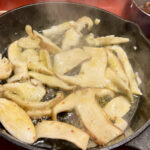

Autumn Olive Matsutake
During the months of October and November, my wife, Léna, and I visited the Coastal Pine Barrens of Cape Cod. On a number of occasions, we were successful in finding Tricholoma magnivelare, which is our version of the Asian species Tricholoma matsutake found in Eurasia and reported in other parts of the world. The following day, we had a family gathering and decided to prepare this appetizer.
Ingredients
- 1 lb matsutake
- 5 tbsp extra virgin olive oil evoo *
- 1 tbsp Autumn Olive jam recipe below, see Notes ** for substitute
- 1 tsp Dijon mustard
- ½ tsp smoked paprika
- ¼ tsp black pepper
- ¼ tsp coarse sea salt
- 1 lime juice of one half, other half as garnish
Instructions
Autumn Olive Blend Instructions
- In a bowl combine Autumn Olive jam, Dijon mustard, smoked paprika, black pepper, lime juice, 2 tbsp olive oil and loosely mix, so that there is still some distinction of individual colors from each ingredient.
- You are striving for a yogurt-like consistency.
- Set it aside.
Matsutake Instructions
- Add 3 tbsp olive oil to a cast iron skillet.*
- Cut the mushrooms lengthwise into 1/8-inch sections. Place the slices and set temperature to medium/medium-high.
- Sear the slices on both sides until a golden crust is achieved. When the matsutake has reached this point, lower the temperature to medium-low.
- Coat the slices generously with the Autumn Olive Blend** on all sides.
- Continue cooking for 3 more minutes before turning off the stovetop.
- Season with coarse sea salt and serve hot with lime.
Notes
Ari Stamatiou:
The results exceeded our expectations. Its umami flavor paired very well with the pasta and rice dishes we had prepared.
Takeaway insights: Because of its assertive and highly variable odor, we decided to cook the slices in a cast-iron skillet with evoo, fully cognizant that olive oil could overpower delicate flavors. That being said, the matsutake’s attributes refused to be masked.
** Every year we collect Autumn Olive berries to make jam. We make it almost as thick as tomato paste and not overly sweet. The flavor is tangy, mildly spicy, and has notes of cherry. On crackers and croissants, the jam spreads smoothly and evenly. Since the jam is not commercially available, a good substitute for this recipe could be sour cherry jam.
Culinary characteristics of matsutake: The fresh matsutake is firm, smooth and ivory white. The odor is strong and pungent. Pay attention to the odor changes of each successive slice with the knife; the variability is unlike any other mushroom. Texture-wise, it is very much like bacon, in that at the start of the cooking process it is pliable and at the end it becomes firm.
Editorial Note:
Jonathan Applefield related this recipe in an article in NAMA's Fall 2025 Mycophile: Ari Stamatiou, a member of the Boston Mycology Club, shared this recipe with me at the Club’s annual banquet. A geologist by training, his attention to the land and its subtle textures is matched by his infectious enthusiasm for mycophagy.
Tried this recipe?Let us know how it was!
NAMA Store >